

Health Insurance, Explained Without the Jargon
At its simplest, health insurance is a deal you make with an insurance company. You pay them a set amount every month, and in return they agree to share the cost of your medical care, whether that’s a routine physical, a prescription you take daily, or a hospital stay you never saw coming.
But to compare plans properly, you really do need to understand four terms. Skipping this part is why a lot of people end up with coverage that surprises them at the worst possible moment. If you want a deeper look at the full vocabulary, our guide to health insurance terms every policyholder should know is a good place to start.
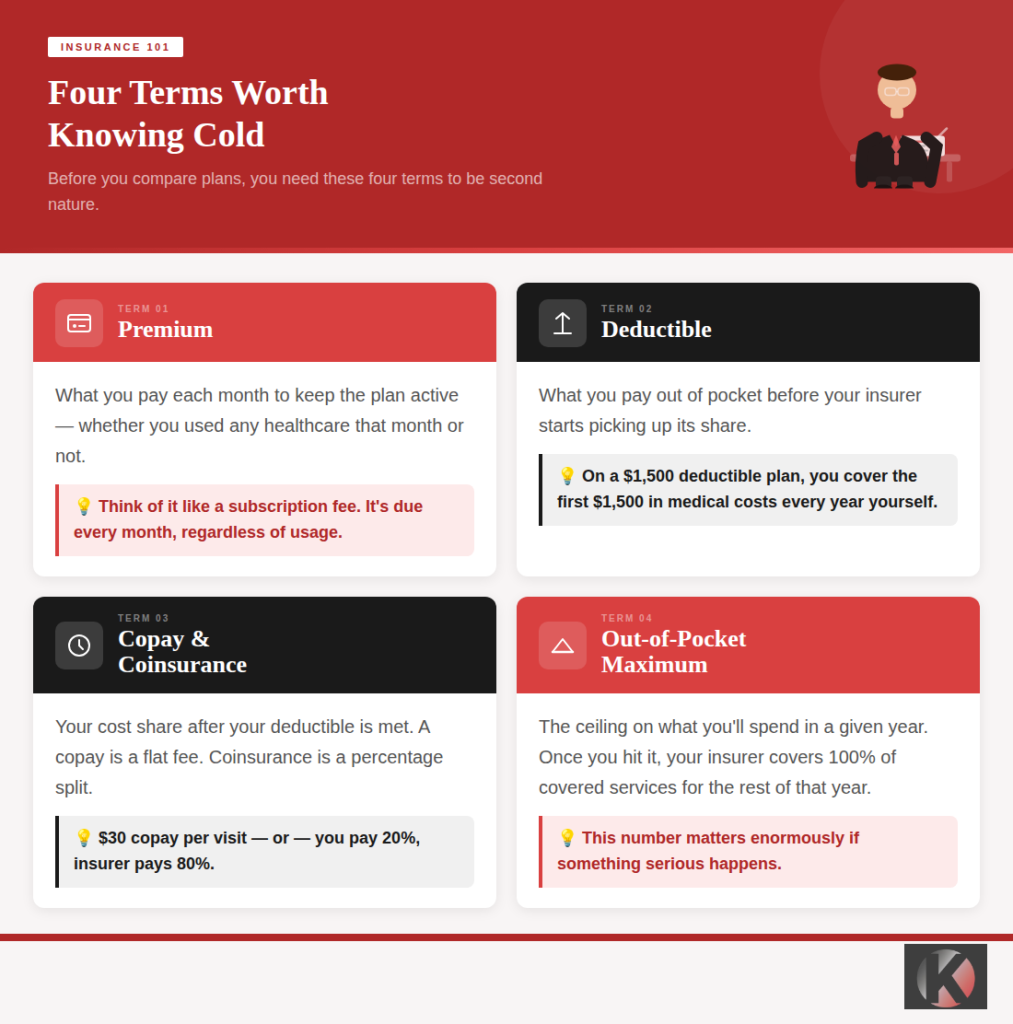
Beyond the financial protection, there’s a practical reason health insurance changes how people use the healthcare system. People with coverage go to a doctor when something feels off. People without it often wait. And waiting tends to turn manageable problems into expensive ones.
Why 2026 Is a Particularly Bad Year to Skip Coverage
Medical costs have been climbing steadily for years. The average three-day hospital stay now runs past $30,000 in most parts of the country. A cancer diagnosis can rack up six figures in treatment bills within just a few months of the initial finding. These aren’t worst-case numbers anymore. They’re fairly typical.
But here’s what’s changed more recently. The nature of work is different now than it was even five years ago.
Over 60 million Americans are freelancing or working as independent contractors at this point. Most of them don’t get health benefits from an employer. They’re on their own. The same goes for small business owners, who need to sort out coverage for themselves and often for their employees too, which turns out to be a surprisingly complicated task if you’ve never done it before.
Even people who do have employer-sponsored insurance are often less protected than they realize. Deductibles have crept up significantly over the past decade. Networks have gotten narrower. And with more teams working remotely than ever, it’s worth asking whether your employees are truly protected under your current plan. The old assumption that having any workplace coverage means you’re taken care of is not really accurate anymore.
And then there’s the ACA marketplace, which gets overlooked more than it should. Premium subsidies have made individual coverage genuinely affordable for a lot of people, but that only helps if you actually know what you qualify for. A surprising number of Texans are eligible for credits that would dramatically lower their monthly bill and simply don’t know it.
The short version is: now is not a great time to go without coverage and assume you’ll deal with it if something comes up.
The Different Types of Health Insurance Plans
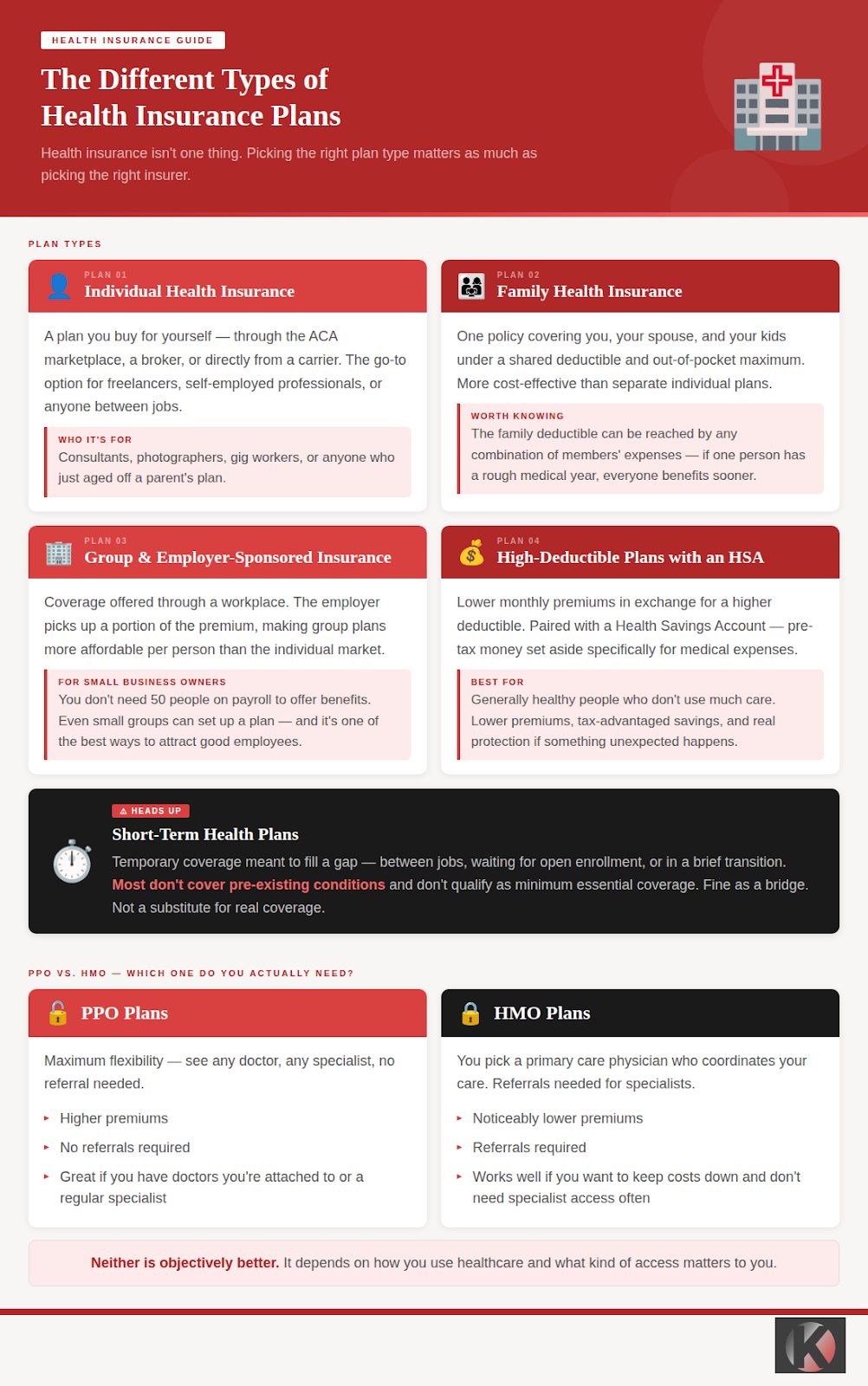
One thing that confuses a lot of people is that health insurance isn’t one thing. There are several distinct plan types, and picking the right category matters as much as picking the right insurer. Here’s what each one actually is.
Individual Health Insurance
This is a plan you buy for yourself, separate from any employer. You can get it through the ACA marketplace, through a broker, or directly from a carrier. It’s the go-to option for freelancers, self-employed professionals, people between jobs, or anyone whose employer doesn’t offer benefits.
Who it’s for: Anyone buying coverage on their own. A 34-year-old consultant who left her corporate job and needs her own plan. A photographer who works weddings full time. Someone who aged off a parent’s plan and is navigating coverage for the first time.
Family Health Insurance
One policy that covers you, your spouse, and your kids under a shared deductible and out-of-pocket maximum. Generally more cost-effective than buying separate individual plans, especially when more than one family member is likely to use healthcare in a given year.
Worth knowing: On most family plans, the family deductible can be reached by any combination of family members’ expenses. So if one person has a rough medical year, everyone starts getting the cost-sharing benefit sooner. For employers, it’s also worth exploring inclusive family-building benefits that go beyond the standard family plan and help future-proof your workforce.
Want to see how these costs compare in real-world scenarios? Check out Family Health Insurance Cost vs Individual Plans for a detailed breakdown.
Group and Employer-Sponsored Insurance
Coverage that’s offered through a workplace. The employer typically picks up a portion of the premium, which makes group plans more affordable per person than individual market coverage, at least in most cases. Small businesses can set up group plans too, even with just a handful of employees.
For small business owners: Offering a group plan is one of the better ways to attract good employees. It’s often more accessible than business owners assume, and pairing it with employee wellness programs that lower insurance costs can make the whole package even more competitive, without necessarily spending more. You don’t need 50 people on payroll to offer benefits.
Short-Term Health Plans
These are exactly what they sound like: temporary coverage meant to fill a gap. Between jobs. Waiting for open enrollment to open. In a transition that leaves you without your usual plan for a few months.
The catch is that short-term plans are much less comprehensive than ACA-compliant coverage. They usually don’t cover pre-existing conditions, and a common question is whether short-term medical plans qualify as minimum essential coverage. The short answer: most don’t. They’re fine for a bridge, but not a substitute for real coverage.
High-Deductible Plans With an HSA
HDHPs have lower monthly premiums than most other plan types. The trade-off is a higher deductible, meaning you absorb more costs upfront if you need care. They’re commonly paired with a Health Savings Account, which lets you set aside pre-tax money specifically for medical expenses.
For people who are generally healthy and don’t use much care, this combination can be a genuinely smart financial move. Lower premiums, tax-advantaged savings, and real protection if something unexpected happens.
PPO vs. HMO: Which One Do You Actually Need?
This is the question that comes up constantly, and the answer is genuinely different for different people.
- PPO plans: give you the most flexibility. You can see any doctor, go to any specialist, and don’t need a referral to do it. That freedom costs more in premiums, but if you have doctors you’re attached to or a specialist you see regularly, it may well be worth it.
- HMO plans: work differently. You pick a primary care physician who becomes the point person for your care, and you need referrals to see specialists. The upside is that premiums tend to be noticeably lower. They work well for people who don’t need a lot of specialist access and want to keep costs down.
Neither is objectively better. It depends on how you use healthcare and what kind of access matters to you.
What Does Health Insurance Actually Cost in 2026?
This is honestly the question most people want answered first, and the frustrating but true answer is: it depends. Your premium is shaped by a handful of factors specific to you, not just a national average.
Age plays a big role. Under ACA rules, insurers can charge older enrollees up to three times what they charge younger ones. Where you live matters too since healthcare costs vary meaningfully between states and even between different regions within Texas. The plan tier you pick, whether that’s Bronze, Silver, Gold, or Platinum, affects both your monthly premium and how much you’ll pay when you actually use care. And if you smoke, that can add up to 50% to your premium on some plans.
For people buying on the ACA marketplace, household income is probably the biggest variable of all. Subsidies exist specifically to make coverage more accessible, and a lot of people who assume they make too much to qualify are wrong about that.
| Rough Benchmarks for 2026 Monthly Premiums These are before-subsidy figures based on national averages. Actual rates vary by location and carrier. Individual, age 30, Silver plan: $350 to $550 per month Family of four, Silver plan: $1,200 to $1,800 per month Self-employed individual with ACA subsidy: $150 to $300 per month is achievable for many people |
These figures are averages, not quotes. The only way to know what you’d actually pay is to run real numbers based on your age, zip code, and income. That’s something an independent broker can do for you in a pretty short conversation.
Individual Plans vs. Family Plans: Which Makes More Sense?
People ask this one a lot, usually because the sticker price on a family plan feels high and they wonder if they’d come out ahead just buying separate individual policies.
Most of the time, the family plan wins. A few reasons for that.
First, the shared deductible. On a family plan, any combination of family members’ expenses counts toward that number, so you’re not stuck waiting for each person to individually hit their own deductible before insurance kicks in. Second, you’re dealing with one plan, one insurer, and one renewal date instead of juggling multiple policies. That simplicity is worth something. And third, the per-person cost on a family plan is usually better than what you’d pay stacking individual plans.
That said, individual plans can make more sense in specific situations. If one spouse is already covered through an employer. If family members have very different healthcare needs that make separate plans a better fit. Or if ACA subsidies apply differently to different members of the household.
Running both scenarios with real numbers is the most honest way to answer this question for your specific situation.
How to Actually Choose the Right Health Insurance Plan
Most people approach this backwards, and there’s real psychology behind it. They sort by price, pick the lowest monthly premium, and call it done. If you want to understand why most people get plan selection wrong, it often comes down to prioritizing visible short-term costs over total annual value. Then they’re surprised when a $200-a-month Bronze plan with a $7,000 deductible turns out to be much more expensive than a $450-a-month Silver plan after an actual medical event.
The premium is just one part of what you’ll pay. Here’s how to think through the decision properly.
1. Start with how you actually use healthcare. Be honest about this. How many times did you see a doctor last year? Do you have ongoing prescriptions? Any specialists you rely on? Someone who’s healthy and rarely needs care has very different needs from someone managing a chronic condition.
2. Check that your doctors are in-network before you commit. This is a step people routinely skip and then regret. Call the insurer’s member services line or use the provider search tool. Don’t assume. Out-of-network care is dramatically more expensive, and finding out after the fact is a miserable experience.
3. Add up the full year, not just the monthly cost. Multiply the premium by 12, then estimate your likely out-of-pocket costs based on how you use care. A plan that looks cheap monthly can be very expensive annually if you have a deductible you’ll likely hit.
4. Check your prescriptions. If you take regular medications, pull up the plan’s drug formulary and make sure your prescriptions are covered, and at what tier. Drugs can vary significantly in cost across different plans.
5. Compare at least three options before deciding. Differences between plans at the same coverage tier can be significant. Rate differences between carriers for the same level of coverage can also surprise you.
This is genuinely where working with an independent broker pays off. When you buy directly from a single carrier, you’re only seeing their products. An independent agency like Keen Coverage compares options across multiple insurers, so you get a much fuller picture of what’s available at your price point, and you have someone who can explain the tradeoffs in plain English rather than insurance-speak.

The Mistakes That Come Up Over and Over Again
After helping a lot of people sort through their options, the same errors tend to repeat themselves. Most are avoidable if you know what to watch for.
• Choosing a plan purely based on the monthly premium: The lowest premium doesn’t mean the lowest cost. A plan charging you $200 a month with a $7,000 deductible and thin coverage can cost far more in a real-use year than a Silver plan at $450 a month. Run the full-year math.
• Not actually reading the exclusions: Most people don’t read what isn’t covered. Some plans exclude mental health services, certain specialist visits without pre-authorization, specific treatments, or particular medications. You only find out what’s not covered when you try to use it.
• Assuming your doctors are in-network: Don’t assume. Check. Your doctor being in-network on your old plan doesn’t mean they’ll be in-network on your new one. Verify before enrolling.
• Missing enrollment windows: Outside of qualifying life events like job loss, marriage, or having a child, you typically can’t buy or switch coverage until the next open enrollment period. Miss the window and you could be waiting months without coverage.
• Going underinsured to cut the monthly cost: This one particularly hits younger, healthier people who figure they probably won’t need much care. One bad accident or one unexpected diagnosis changes the math in a hurry. A single hospitalization can take years to pay down without adequate coverage.
How to Keep Your Premiums Reasonable
Getting solid coverage doesn’t automatically mean overpaying. A few things actually move the needle.
• Check whether you qualify for ACA subsidies before anything else: A lot of people rule themselves out without checking. Income-based tax credits on the ACA marketplace can bring monthly premiums down dramatically. The eligibility range is broader than most people assume, and it’s worth taking five minutes to look up what you’d qualify for.
• Pair an HDHP with an HSA if you’re generally healthy: The premium savings on a high-deductible plan can be substantial. Putting that difference into a Health Savings Account gives you tax-free money specifically set aside for medical expenses, and whatever you don’t use rolls over year after year. Over time, it adds up.
• Ask about bundling health, dental, and vision: Some carriers offer multi-policy discounts when you combine coverage types. It’s not universal, but it’s worth asking when you’re shopping.
• Review your plan every year, not just once: Your life changes. Your income changes. Your health needs change. There’s a reason why an annual insurance policy review matters more than people realize: the plan that made sense two years ago might not be the best fit today, and there may be better options at the same price. It takes maybe 30 minutes and can easily save a few hundred dollars.
• Don’t wait until open enrollment is almost over: Shopping with a deadline means making faster, worse decisions. Give yourself enough time to actually compare options and ask questions.
Frequently Asked Questions
There’s no single answer that fits everyone, but for most self-employed people in Texas, the ACA marketplace is the right starting point. Depending on your income, you may qualify for subsidies that make coverage far more affordable than you’d expect. An HDHP paired with an HSA is worth serious consideration if you’re in decent health and don’t use a lot of medical services. The real answer comes from running actual quotes based on your specific situation, not from picking something off a generic list. A broker who works with multiple carriers can do that comparison for you.
For a family of four on a Silver-tier ACA plan, the before-subsidy range is roughly $1,200 to $1,800 per month. That’s a national average, and Texas rates sit within that range for most areas. If your household income qualifies for premium tax credits, you could pay significantly less. The ages of the people being covered, your location, and which plan tier you choose all affect the final number. Getting actual quotes is the only way to know what you’d genuinely pay.
A PPO lets you see any doctor or specialist without a referral and gives you more flexibility in choosing providers, though you’ll pay more for that flexibility in premiums. An HMO requires you to work through a primary care physician who manages referrals to specialists, and care generally needs to stay within the network. The trade-off is lower premiums. If you rarely need specialist care and want to keep costs down, an HMO often makes sense. If you have specific doctors you want to keep seeing or need regular specialist access, a PPO is usually the better fit.
Yes, and many freelancers are paying more than they need to. The ACA marketplace offers subsidized coverage based on household income, and self-employed individuals can also deduct health insurance premiums on their federal taxes. A lot of people freelancing in Texas assume individual coverage is out of reach financially, check the numbers before making that assumption. You may qualify for more help than you think. An independent broker can walk you through the options without any obligation to buy.
The federal ACA open enrollment window typically runs from November 1 through January 15. Some state-run exchanges have slightly different dates. Outside of open enrollment, you can only sign up for a new plan if you experience a qualifying life event, things like losing existing coverage, getting married, having a child, or moving to a new area. If you miss the window without a qualifying event, you’ll generally be waiting until the following year.
It can be, but it depends on your health and how much healthcare you actually use. HDHPs make the most sense for people who are generally healthy, rarely visit a doctor, and want to keep monthly costs low while still having protection against a major event. The ability to contribute to a Health Savings Account is a real financial benefit. If you have ongoing health conditions, take regular medications, or expect significant medical costs in the coming year, the math usually favors a lower-deductible plan even with the higher premium.
Small businesses can offer group health insurance through a private broker or through the ACA’s SHOP marketplace. With a group plan, the employer typically covers a portion of each employee’s premium, which makes coverage more accessible for everyone on the team. You don’t need a large workforce to offer benefits. Even businesses with two or three employees can access group coverage. It’s also one of the more effective ways to attract and keep good people. An independent broker can help you compare group plan options across carriers and figure out what makes financial sense for your business specifically.
One Conversation Can Change What You Pay
If you’ve made it this far, you probably already know that just picking the first plan you see isn’t the right move. The difference between a plan that works for you and one that leaves you exposed, or one that costs $400 more per month than it needs to, often comes down to taking the time to actually compare options.
That’s harder to do alone than it should be. Insurance company websites are designed to sell you their products, not to help you compare them against competitors. Navigating that on your own, while also trying to decode deductibles, networks, and formularies, takes more time and expertise than most people have to spare.
Keen Coverage is an independent agency, which means we work with multiple carriers rather than being tied to any one of them. We serve individuals, families, self-employed professionals, and small businesses across Texas. Our job is to understand your situation and find coverage that actually fits it, not to push you toward whatever pays us the most.
A quote takes a few minutes. A conversation to talk through your options costs you nothing. If you haven’t reviewed your coverage recently, or if you’re shopping for the first time, it’s worth making the call.
| Ready to Find a Plan That Actually Fits? Keen Coverage compares plans from multiple carriers to find you the best fit in Texas. Visit keencoverage.com for a free quote or to speak with an advisor. |
Related Posts
Health Insurance Plan Comparison Guide
Average Health Insurance Cost by Age
Family Health Insurance Cost vs Individual Plans
How to Reduce Health Insurance Premiums Legally
Top Reasons Health Insurance Claims Get Rejected