

Marcus and his wife had been on separate individual plans for two years. It made sense when they first started dating. They were both working, both had their own employers to navigate, and combining anything felt premature. Then they got married, had a kid, and suddenly managing two renewal dates, two premium payments, and two sets of deductibles started to feel like a second job.
When they finally sat down and ran the numbers side by side with an advisor, they were paying about $340 more per month combined than they would have on a single family plan. Over a year, that’s close to $4,000 in unnecessary spending.
That’s the version of this question most people don’t think to ask until someone prompts them. Is a family plan actually cheaper than keeping everyone on individual policies? The answer is usually yes. But not always, and understanding when each option wins is what saves you real money.
What Each Plan Type Costs in 2026
Before comparing them directly, it helps to have a clear picture of what individual and family plans typically cost on the ACA marketplace this year.
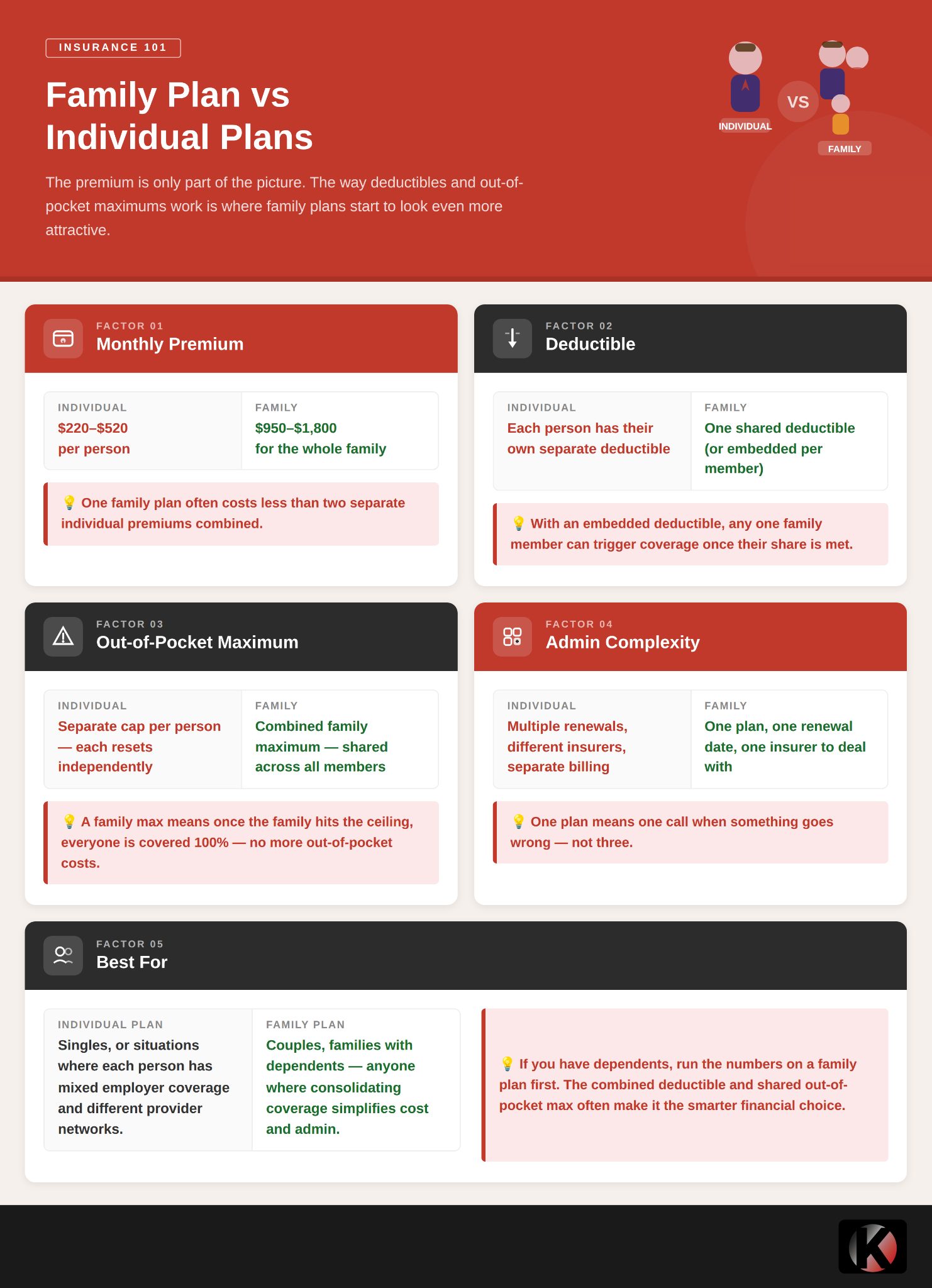
For a single adult on an individual Silver plan, monthly premiums in 2026 average between $220 and $520 before subsidies, depending on age and location. For a couple in their mid-30s, stacking two individual plans puts you somewhere in the $500 to $900 range combined. Add a child and you’re looking at another $150 to $200 per month if that child has their own individual policy.
A family plan, by comparison, covers everyone under one policy. For a family of four on a Silver-tier ACA plan, the before-subsidy premium typically runs between $950 and $1,800 per month. That sounds like a lot until you realize it’s often less than the sum of separate individual premiums for the same people.
The gap between combined individual premiums and a single family plan premium tends to narrow as families get larger. For two people with no kids, it’s worth doing the math both ways before assuming. For a family with children, the family plan almost always comes out ahead on premium.
Family Plan vs Individual Plans: How They Actually Differ
The Deductible Difference Matters More Than People Realize
On separate individual plans, each person has to meet their own deductible before insurance starts sharing their costs. A family with three members each carrying a $2,500 deductible could theoretically spend $7,500 out of pocket before anyone sees significant cost-sharing kick in.
A family plan works differently. Most family plans use what’s called an embedded deductible structure, meaning the family shares one overall deductible, but any individual within the family can also trigger cost-sharing once they hit their personal embedded limit. So if one family member has an expensive medical year, they don’t have to wait for the rest of the family to catch up.
The practical result is that families who experience uneven medical use across members, one healthy adult, one parent with a chronic condition, a kid who keeps ending up in urgent care, tend to get much better financial protection under a family plan than under separate individual policies.
When Separate Individual Plans Actually Make More Sense
The family plan wins in most situations, but not all of them. There are a few cases where keeping coverage separate is the smarter move.
• One spouse has employer coverage: If your partner gets health benefits through their job, adding you or the kids to their employer plan is often cheaper than buying a family policy on the open market. The employer typically subsidizes a portion of the premium, which changes the math significantly.
• Very different healthcare needs: If one person needs extensive specialist access and a broad PPO network, while the other is healthy and rarely visits a doctor, separate plans let each person’s coverage match their actual needs rather than forcing a compromise.
• Subsidy eligibility is split: ACA subsidies are calculated based on household income. In some situations, structuring coverage separately can affect how much tax credit each person qualifies for. It’s worth modeling both scenarios with actual numbers.
• Short-term or transitional situation: If one family member is in a temporary gap, between jobs, waiting for coverage to start, or aging off a parent’s plan, a short-term individual policy bridges that gap without disrupting the rest of the household’s coverage.
These aren’t edge cases. They come up regularly. The right answer for your household depends on your specific employment situation, income, ages, and healthcare habits.
Adding a Spouse or Child: What It Actually Costs
One of the most common questions people ask after a life change, a marriage, a new baby, a dependent moving back home, is whether to add that person to an existing plan or set them up on their own.
Adding a spouse to a family plan is usually cheaper per person than two individual policies, but not always. The age difference between spouses matters, because premiums are age-rated. If one spouse is significantly older, the family plan premium reflects that. Running a quick comparison before assuming is worth the five minutes.
Adding a child to a family plan is almost always cost-effective. Children’s individual premiums are low, but the administrative simplicity of one policy and one deductible pool typically outweighs any marginal premium savings from keeping them separate. Children can also stay on a parent’s plan until age 26, which is worth factoring into longer-term planning.
How to Figure Out Which Option Is Right for Your Household
There’s no shortcut here that works for everyone. The decision depends on too many variables that are specific to your family. But there’s a clear process that makes the comparison manageable.
• List everyone who needs coverage and their ages, so you have the raw inputs for both scenarios.
• Check whether any household member has access to employer-sponsored coverage and at what cost.
• Run quotes for a family plan and for separate individual plans using actual carrier rates in your zip code.
• Compare the full-year cost of each option: annual premium plus likely out-of-pocket costs given how each person typically uses healthcare.
• Check subsidy eligibility under both scenarios if you’re buying through the ACA marketplace.
Not Sure Which Way Your Numbers Fall?
This is exactly the kind of question where spending 20 minutes with an independent broker pays for itself many times over. Running the family plan versus individual plan comparison with real quotes, for your ages, your zip code, and your income, gives you a clear answer instead of a guess.
Keen Coverage works with families, couples, and households across Texas. We compare options from multiple carriers and can model both scenarios for you so you know what you’d actually pay, not just what the national averages suggest.
No obligation to buy. No pressure to pick what we think is best. Just a straight comparison so you can make an informed call.
| Get a Side-by-Side Comparison for Your Household ,contact us to compare family and individual plan quotes across multiple Texas carriers. |
Want a deeper understanding of how health insurance works? Explore our complete Health Insurance Guide.