

Our team at Keen Coverage has been working with self-employed professionals across Texas for years, and we keep hearing the same story. “Yeah, I know I need life insurance. I’ll get to it next month.”
Next month turns into next year. And suddenly you’re 45 with a mortgage, two kids heading to college, and a business that’s personally guaranteed on about six different loans.
Here’s what nobody tells you when you start your own business. That freedom you love? It comes with a catch. You don’t have some corporate HR department automatically enrolling you in group life insurance. There’s no safety net unless you build it yourself.
And we get it. When you’re hustling to land clients, dealing with invoices, and trying to keep the lights on, life insurance feels like something you can put off. But what happens if you can’t put it off anymore? What happens if something goes wrong tomorrow?
Your spouse is left trying to figure out how to pay the mortgage. Your kids’ college savings disappear. Those business loans you signed for?, still need to get paid.
Why Being Self-Employed Changes Everything
Traditional employees have it easy when it comes to benefits. They show up to work, and boom, they’ve got life insurance through their employer. Usually costs them nothing or maybe a few bucks a paycheck.
But you? You’re different.
You are the business. Your ability to work is literally what keeps money coming in. If you’re not around, that revenue stream just stops. Period.
We worked with a freelance IT consultant in Dallas last year. Guy was making great money, supporting his family, and had this whole setup going. Never thought twice about life insurance because he was healthy, only 38, felt invincible. Then he had a health scare that put him in the hospital for three weeks.
Thankfully he recovered. But it hit him hard. Three weeks of zero income. Medical bills stacking up. And the realization that if it had been worse, his wife and kids would’ve been completely on their own.
That’s the thing about self-employment that we see every day at Keen Coverage. There’s no paid time off. No disability pay. No life insurance payout unless you’ve already set it up.
Running your own business means your family depends on you financially. Learn how to choose the right coverage, compare policy types, and avoid costly mistakes in our pillar guide: The Complete Guide to Life Insurance in Texas.
Breaking Down Your Options (Without the Insurance Jargon)
Term Life: Where Most People Start
Term life is pretty straightforward. You pick how long you want coverage (usually 10, 20, or 30 years), and if you die during that time, your beneficiaries get the payout. Simple as that.
For most self-employed folks, term makes the most sense. It’s affordable, and it covers you during the years when you’ve got the most financial obligations. Think about it. You probably don’t need massive coverage when you’re 75 and the house is paid off. But right now? When you’ve got 15 years left on your mortgage and kids still in high school? Yeah, you need coverage.
A 35-year-old self-employed consultant here in Texas can usually get $500,000 of coverage for maybe $40 a month. That’s less than most people spend on their daily Starbucks habit, and it could literally save their family’s financial future.
Whole Life and Universal Life: The Long Game
These are permanent policies, meaning they don’t expire after a set time. They also build cash value, which is where things get interesting for business owners.
We’ll be honest with you. Permanent life insurance costs a lot more than term. But here’s why some self-employed professionals we work with still go for it. That cash value grows tax-deferred, and you can borrow against it. Need working capital for your business? Want to fund a major purchase without touching your business accounts? That cash value is sitting there.
Plus, if you don’t have a 401(k) match from an employer (because, you know, you’re the employer), permanent life insurance can work as another piece of your retirement planning puzzle.
Not everyone needs it. But for the right situation, it makes sense.
When Your Health Isn’t Perfect
Got high blood pressure? Diabetes? A few too many pounds around the middle? (Join the club. Texas BBQ will do that to you.)
Traditional life insurance companies will either charge you more or flat-out decline you if your health isn’t great. But there are simplified issue, and guaranteed issue policies that don’t require a full medical exam. They’re more expensive and the coverage limits are lower, but at least it’s something.
Our team at Keen Coverage works with carriers that offer these options, so we can find solutions even when your health makes traditional underwriting challenging.
The Tax Stuff Nobody Explains Properly
Let’s talk about taxes. Because this is where a lot of self-employed people get confused, and our agents field questions about this constantly.
Your regular personal life insurance premiums? Not tax-deductible. Just isn’t. The IRS doesn’t care that you’re self-employed. If you’re buying a policy to protect your family, you’re paying with after-tax dollars.
But here’s where it gets tricky. If you set up your business as an LLC, S-corp, or partnership, and you structure the life insurance as part of an employee benefit plan (even if you’re the only employee), you might be able to deduct those premiums as a business expense.
Might. Maybe. It depends.
And this is where we always tell people: talk to a CPA who actually understands self-employment taxes in Texas. Don’t just assume. Don’t rely on what you read on some random internet forum. Get real professional advice, because if you mess this up, the IRS will absolutely come knocking.
Figuring Out How Much You Actually Need
Everyone throws around that “10 times your income” rule. And yeah, it’s a starting point. But it’s not the whole story, and our agents know this from working with hundreds of self-employed professionals.
Think about what your family would actually need if you weren’t around:
Your income for how many years? If you’ve got young kids, probably 20+ years of income replacement.
Business debts. Did you personally guarantee any loans? Because your spouse is going to be on the hook for those.
The mortgage. College funds. Final expenses (funerals aren’t cheap, unfortunately).
If you’ve got business partners, what about a buy-sell agreement? You need coverage that lets them buy out your share without bankrupting themselves.
We worked with a self-employed marketing consultant in Houston who was earning about $180,000 a year. She had three kids under 10, a $400,000 mortgage, and business loans of about $75,000. Our team calculated she needed close to $2 million in coverage. Sounds like a lot, but when you break down what her family would actually face, it made total sense.
Finding an Agent Who Actually Gets It
Here’s the thing about working with insurance agents in Texas. You want someone who understands self-employment. Not just theoretically, but actually gets what you’re dealing with.
Generic online calculators are useless for self-employed folks. They don’t account for variable income, business obligations, or the fact that your tax situation is way more complicated than someone with a W-2.
Quality insurance companies in Dallas, Texas, and across the state have agents who specialize in working with business owners. They ask the right questions. They understand that your income might swing 30% year to year and that’s totally normal. They get that you need coverage that fits both your personal family needs and your business structure.
When you’re looking at insurance agencies in Texas, find someone who:
Ask about your business entity type (sole proprietor, LLC, S-corp, etc.)
Wants to see your tax returns, not just your best month’s income
Can explain why one carrier might be better than another for your specific situation
Doesn’t just push the most expensive product
Actually returns your calls and emails (seriously, this shouldn’t be rare, but it is)
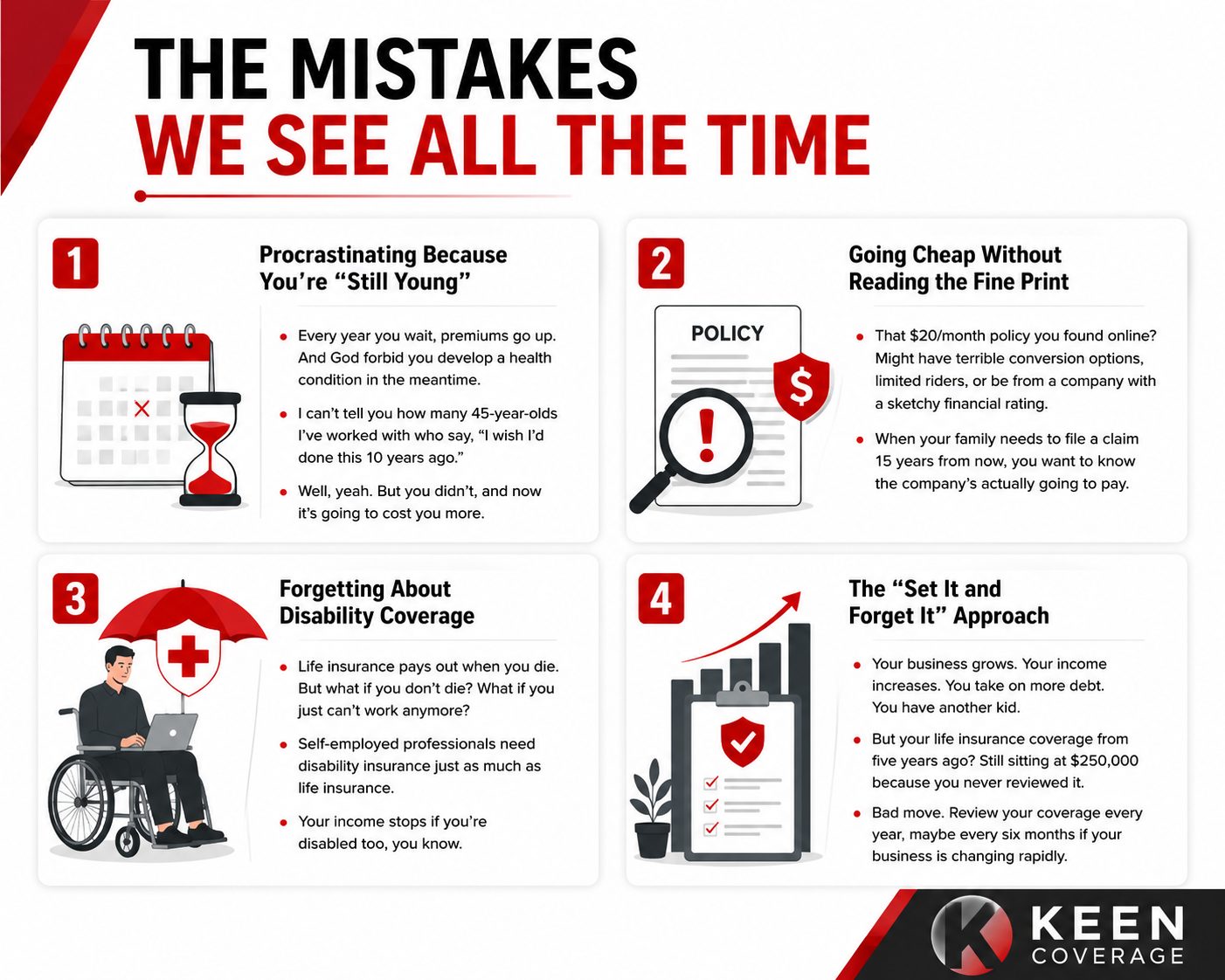
The Mistakes we See All the Time
Procrastinating Because You’re “Still Young”
Every year you wait, premiums go up. And God forbid you develop a health condition in the meantime. I can’t tell you how many 45-year-olds I’ve worked with who say, “I wish I’d done this 10 years ago.” Well, yeah. But you didn’t, and now it’s going to cost you more.
Going Cheap Without Reading the Fine Print
That $20/month policy you found online? Might have terrible conversion options, limited riders, or be from a company with a sketchy financial rating. When your family needs to file a claim 15 years from now, you want to know the company’s actually going to pay.
Forgetting About Disability Coverage
Life insurance pays out when you die. But what if you don’t die? What if you just can’t work anymore? Self-employed professionals need disability insurance just as much as life insurance. Your income stops if you’re disabled too, you know.
The “Set It and Forget It” Approach
Your business grows. Your income increases. You take on more debt. You have another kid. But your life insurance coverage from five years ago? Still sitting at $250,000 because you never reviewed it.
Bad move. Review your coverage every year, maybe every six months if your business is changing rapidly.
What Makes Texas Different
No state income tax. This is huge, people. More of your money stays in your pocket, which means you can actually afford better coverage than someone making the same income in California or New York.
But here’s the flip side. Texas is crazy competitive for entrepreneurs and self-employed professionals. That’s great for business opportunities, but it also means your income can be less stable than in states with fewer competitors.
Plus, Texas has community property laws that affect how life insurance beneficiaries work if you’re married. Your spouse might have rights to the policy even if you named someone else as beneficiary. Seriously, talk to insurance agents in Texas who know these state-specific rules.
Shopping for Coverage (The Right Way)
Don’t just grab the first quote you see. Insurance companies use wildly different underwriting criteria. One carrier might rate you standard. Another might give you preferred rates. A third might want to charge you extra because of some health thing that the first two didn’t care about.
This is exactly why Keen Coverage works as an independent agency representing multiple insurance companies in Dallas, Texas, and throughout the state. We can shop your application to different carriers and find the best fit for your specific situation.
Look at financial strength ratings. A.M. Best, Moody’s, Standard & Poor’s. These ratings tell you whether the company’s going to be around in 30 years when your family needs to collect. Our team only works with highly-rated carriers, so you don’t have to worry about whether they’ll actually pay claims.
Ask about customer service. How hard is it to actually talk to someone? What’s the claims process like? You’re not buying this policy for you, you’re buying it for your family. We make sure you’re working with carriers that make it easy for them when the time comes.
Putting It All Together
Start by actually calculating what you need. Not guessing. Sit down with your financial obligations, your income, your debts, and figure out the real number.
Decide if you want a term, permanent, or a combination of both. A lot of self-employed professionals do a “layering” approach. Big term policy for the high-risk years, smaller permanent policy for final expenses and cash value.
Then connect with our team at Keen Coverage. We work specifically with self-employed professionals and can shop multiple carriers on your behalf. We’ll get you quotes from at least three different insurance companies in Dallas, Texas, and across the state. We compare not just price, but coverage options, conversion rights, riders, everything.
And once you’ve got coverage? Don’t just forget about it. Check in with us annually. Your business will change. Your life will change. Your insurance needs to keep up.
Real Talk: This Matters More Than You Think
We’ve seen what happens when self-employed professionals don’t have life insurance. Our team has talked to the widows and widowers trying to figure out how to keep the house. We’ve seen the kids who had to skip college because the money disappeared when a parent died.
It’s brutal. And it’s completely preventable.
You’ve built something as a self-employed professional. Whether it’s a consulting practice, a contracting business, a freelance career, whatever. You’ve created income and opportunity through your own hard work.
Don’t let all that evaporate if something happens to you.
Ready to Actually Do This?
Stop putting it off. Seriously. You’ve read this far, which means you know you need coverage.
Keen Coverage works specifically with self-employed professionals across Texas. We get it. We understand the unique challenges you’re facing because we work with business owners like you every single day. Whether you’re in Dallas, Austin, Houston, San Antonio, or anywhere else in Texas, we can connect you with insurance agents who specialize in self-employed coverage.
Get your quote today. See what coverage actually costs. Compare different options. Find out what makes sense for your specific situation.
Our team works with the top insurance companies in Dallas, Texas, and throughout the state to find you the best coverage at competitive rates.
Your family’s counting on you. Your business depends on you. Make sure they’re protected even if the worst happens.
Stop reading. Start doing. Get your quote today.
Explore “Guide to Life Insurance in Texas” for a deeper look at policy options, coverage strategies, and smart financial protection tips for Texans.
Questions People Actually Ask Us
Mostly no. Personal life insurance premiums aren’t deductible. The IRS sees it as a personal expense, period.
That said, there are some workarounds. If you’ve got your business set up as an LLC or S-corp and you create an actual employee benefit plan (even if you’re the only “employee”), you might be able to deduct premiums as a business expense. Key person insurance can work this way too.
But honestly? Talk to a CPA before you try anything creative. The last thing you need is an audit because you made assumptions about what’s deductible. Texas CPAs who work with self-employed clients see this stuff all the time and can tell you exactly what applies to your situation.
For most traditional policies, yeah, you do. They’ll want blood work, urine samples, height and weight, blood pressure. Sometimes an EKG if you’re older or requesting a lot of coverage.
But here’s the thing. The medical exam isn’t as bad as people think. A nurse comes to your house or office, takes about 30 minutes, and you’re done. They usually do early morning appointments before you’ve had coffee, which is annoying, but whatever.
If you absolutely can’t do the exam (or if your health is bad enough that you’d get declined), there are simplified issue and guaranteed issue policies. They cost more and the coverage limits are lower, but it’s better than nothing.
Welcome to self-employment, right? One month you’re killing it, the next month you’re wondering where all the clients went.
Insurance companies get it. They’re not stupid. They know self-employed income isn’t steady like a salary. What they do is look at your tax returns for the last 2-3 years and average it out.
So if you made $120k one year, $180k the next, and you’re on track for $150k this year, they’ll average that out and underwrite based on something like $150k. The key is showing consistent profitability. If your business is losing money or your income is dropping significantly, that’s when they get nervous.
Have your tax returns ready when you apply. Schedule Cs, 1120s, whatever you file. Makes the whole process way faster.
Depends. And we know that’s a frustrating answer, but it’s true.
Individual policies are portable. If you close your business or switch careers or do literally anything else with your professional life, the policy stays with you. The beneficiary setup is simple. You own it, you control it, done.
Business-owned policies can have tax advantages depending on your business structure, but they’re more complicated. If you’re thinking about this route, you really need to talk to both a CPA and an insurance agent who specializes in business owner coverage.
For most self-employed professionals we work with in Texas, individual policies make more sense. Simpler, cleaner, no weird complications if your business situation changes.
Your individual life insurance policy doesn’t care what you do for work. You could go from self-employed consultant to Fortune 500 employee to unemployed to whatever. As long as you pay the premiums, the policy stays in force.
This is actually one of the big advantages of getting your own coverage instead of relying on employer group insurance. Employer coverage goes away when you leave the job. Your individual policy? Stay with you forever.
If you go with a simplified issue policy and you’re reasonably healthy, you can have coverage in a few days. Maybe a week.
Traditional underwritten policies take longer. Figure 4-6 weeks from application to approval. Sometimes faster if everything goes smoothly with the medical exam and underwriting. Sometimes slower if they need additional medical records or something comes up.
Some insurance companies in Dallas, Texas, and elsewhere will give you temporary coverage while your application is processing. So you’re not completely unprotected during those 4-6 weeks. Not all carriers do this, but it’s worth asking about.
If you’re in a hurry, tell your agent. They can steer you toward carriers that move faster or simplified issue products that skip the long underwriting process.